Corporate Social Responsibility can build a Prosperous Business


Home


About Us


CSR Initiatives


Arogyagram Open CSR Platform (AOCP)


Ecosystem


ASK Healthcare Network


First Step Challenge


AOCP benefits to Corporates


CSR Services


Swachh Bharat


Rice Bucket Challenge


AOCP benefits to NGOs


Contact Us


Dreams-2-Destiny


JAL Amrit


CSR Initiatives: First Step Challenge


Contest


Coming Soon !!!

Facts and Figures on Women: Economic Empowerment Source: UN Women

Benefits of economic empowerment

*                  When more women work, economies grow. An increase in female labour force participation or a reduction in the gap between womens and mens labour force participation; results in faster economic growth.

*                  Evidence from a range of countries shows that increasing the share of household income controlled by women, either through their own earnings or cash transfers, changes spending in ways that benefit children.

*                  Increasing women and girls education contributes to higher economic growth. Increased educational attainment accounts for about 50% of the economic growth in OECD countries over the past 50 years, of which over half is due to girls having had access to higher levels of education and achieving greater equality in the number of years spent in education between men and women. But, for the majority of women, significant gains in education have not translated into better labour market outcomes.

*                  A study using data from 219 countries from 1970 to 2009 found that, for every one additional year of education for women of reproductive age, child mortality decreased by 9.5%.

*                  Women tend to have less access to formal financial institutions and saving mechanisms. While 55% of men report having an account at a formal financial institution, only 47 per cent of women do worldwide. This gap is largest among lower middle-income economies as well as in South Asia and the Middle East and North Africa.

The world of work

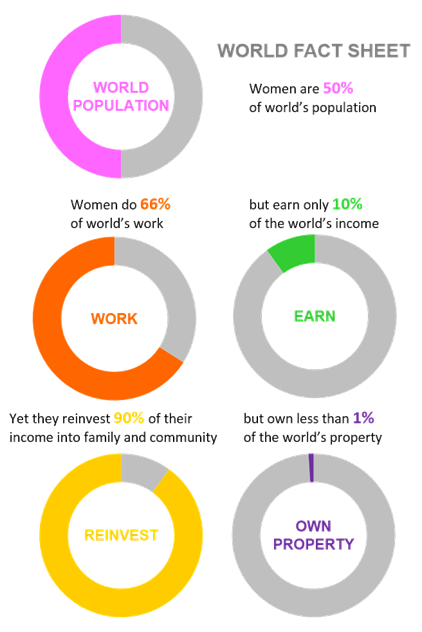
*                  Women continue to participate in labour markets on an unequal basis with men. In 2013, the male employment-to-population ratio stood at 72.2%, while the ratio for females was 47.1 per cent.

*                  Globally, women are paid less than men. Women in most countries earn on average only 60 to 75% of mens wages. Contributing factors include the fact that women are more likely to be wage workers and unpaid family workers; that women are more likely to engage in low-productivity activities and to work in the informal sector; and the view of women as economic dependents.

*                  It is calculated that women could increase their income globally by up to 76% if the employment participation gap and the wage gap between women and men were closed. This is calculated to have a global value of USD 17 trillion.

*                  Women bear disproportionate responsibility for unpaid care work. Women devote 1 to 3 hours more a day to housework than men; 2 to 10 times the amount of time a day to care (for children, elderly, and the sick), and 1 to 4 hours less a day to market activities.

*                  Gender inequalities in time use are still large and persistent in all countries. When paid and unpaid work are combined, women in developing countries work more than men, with less time for education, leisure, political participation and self-care.

*                  Women are more likely than men to work in informal employment. In South Asia, over 80% of women in non-agricultural jobs are in informal employment, in sub-Saharan Africa, 74%, and in Latin America and the Caribbean, 54%. In rural areas, many women derive their livelihoods from small-scale farming, almost always informal and often unpaid.

*                  More women than men work in vulnerable, low-paid, or undervalued jobs. As of 2013, 49.1% of the worlds working women were in vulnerable employment, often unprotected by labour legislation, compared to 46.9% of men. Women were far more likely than men to be in vulnerable employment in East Asia (50.3% versus 42.3%), South-East Asia and the Pacific (63.1% versus 56%), South Asia (80.9% versus 74.4%), North Africa (54.7% versus 30.2%), the Middle East (33.2% versus 23.7%) and Sub-Saharan Africa (nearly 85.5% versus 70.5%).

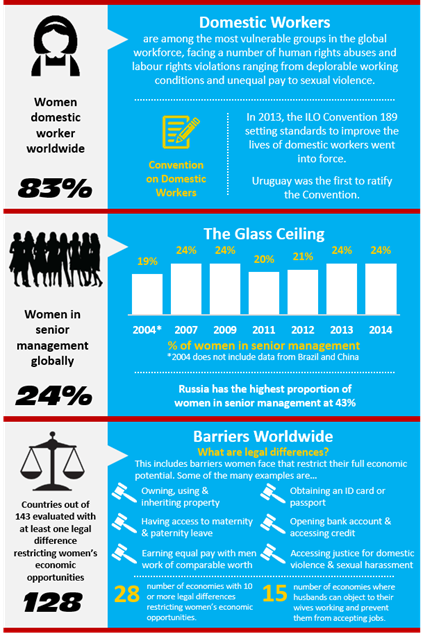
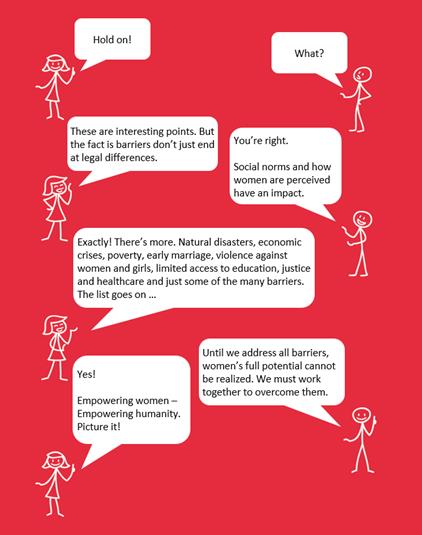
*                  Gender differences in laws affect both developing and developed economies, and women in all regions. Almost 90% of 143 economies studied have at least one legal difference restricting womens economic opportunities. Of those, 79 economies have laws that restrict the types of jobs that women can do. And husbands can object to their wives working and prevent them from accepting jobs in 15 economies.

*                  Womens economic equality is good for business. Companies greatly benefit from increasing leadership opportunities for women, which is shown to increase organizational effectiveness. It is estimated that companies with three or more women in senior management functions score higher in all dimensions of organizational effectiveness.

*                  Ethnicity and gender interact to create especially large pay gaps for minority women.

Essential to agriculture

*                  Women comprise an average of 43% of the agricultural labour force in developing countries, varying considerably across regions from 20% or less in Latin America to 50% or more in parts of Asia and Africa. Despite the regional and sub-regional variation, women make an essential contribution to agriculture across the developing world.

*                  Women farmers control less land than do men, and also have limited access to inputs, seeds, credits, and extension services. Less than 20% of landholders are women. Gender differences in access to land and credit affect the relative ability of female and male farmers and entrepreneurs to invest, operate to scale, and benefit from new economic opportunities.

*                  Women are responsible for household food preparation in 85-90% of cases surveyed in a wide range of countries.

The green economy, sustainable development

*                  From 1990 to 2010, more than 2 billion people gained access to safe drinking water, but 748 million people are still without clean drinking water.

*                  Women, especially those in poverty, appear more vulnerable in the face of natural disasters. A recent study of 141 countries found that more women than men die from natural hazards. Where the socioeconomic status of women is high, men and women die in roughly equal numbers during and after natural disasters, whereas more women than men die (or die at a younger age) where the socioeconomic status of women is low. Women and children are more likely to die than men during disasters.

*                  Women and children bear the main negative impacts of fuel and water collection and transport, with women in many developing countries spending from 1 to 4 hours a day collecting biomass for fuel. A study of time and water poverty in 25 sub-Saharan African countries estimated that women spend at least 16 million hours a day collecting drinking water; men spend 6 million hours; and children, 4 million hours. Gender gaps in domestic and household work, including time spent obtaining water and fuel and processing food, are intensified in contexts of economic crisis, environmental degradation, natural disasters, and inadequate infrastructure and services.


Privacy Policy


Home


Arogyagram Open CSR Platform (AOCP)


ASK Healthcare Network


Disclaimer


About Us


AOCP benefits to Corporates


Swachh Bharat


Terms of Use


Ecosystem


AOCP benefits to NGOs


Dreams-2-Destiny


Contact Us


CSR Services


CSR Initiatives


First Step Challenge


Rice Bucket Challenge


Copyright @2016 Saraswati Aastha Trust. All rights reserved


JAL Amrit